Voting Results
See how Executive Committee ballots have resolved across the lifecycle of JSRs.
The Java Community Process (JCP) Program is the process by which the international Java community standardizes and ratifies specifications for Java technologies. The JCP is designed to produce high-quality specifications through an inclusive, consensus-based model that brings together community review, expert input, and strong technical leadership.
Specifications approved through the JCP are accompanied by a Reference Implementation to prove the specification can be implemented, and a Technology Compatibility Kit (TCK) to test whether implementations comply with the specification. The Executive Committee (EC) guides a specification through each formal stage of the process and helps reconcile any issues between a specification and its associated test suite.
Once you understand the overall JCP flow, it becomes much easier to see where and how you can fit in and contribute.
The JCP has evolved through multiple revisions, each refining the process, voting rules, membership model, transparency requirements, and licensing expectations for the specification, RI, and TCK.
| Version | Date | Highlights |
|---|---|---|
| JCP 2.11 | December 17, 2018 | Streamlined review requirements and introduced iterative JSRs and Errata Maintenance Releases. |
| JCP 2.10 | March 21, 2016 | Defined different types of JCP Membership. |
| JCP 2.9 | August 15, 2012 | Changed the structure and formation of the Executive Committee. |
| JCP 2.8 | October 18, 2011 | Introduced additional transparency requirements for JSRs. |
| JCP 2.7 | May 15, 2009 | Updated the process after the JCP 2.6 revision. |
| JCP 2.6 | March 9, 2004 | Revised process details and clarified operating rules. |
| JCP 2.5 | October 29, 2002 | Updated licensing rules and introduced major IP and process changes. |
| JCP 2.1 | July 10, 2001 | Refined the JCP 2.0 voting rules. |
| JCP 2.0 | June 2, 2000 | Replaced JCP 1.0 for new submissions. |
| JCP 1.0 | December 1998 | Original process model for the Java Community Process. |
The complete current rules are available in the JCP 2: Process Document.
The life cycle below summarizes how a Java Specification Request progresses from proposal to final release and then into long-term maintenance.
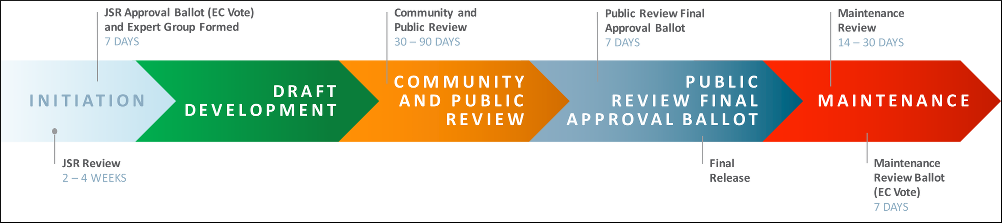
Learn how a Java Specification Request (JSR) moves through its core stages, from initial proposal to long-term maintenance.
See how Executive Committee ballots have resolved across the lifecycle of JSRs.
Read a concise explanation of how and why the Java Community Process was created.
Understand the differences between older and newer versions of the JCP process.
