General Questions
›What is the Java Community Process (JCP)?
The Java Community Process (JCP) is the open, participative process created in 1998 to develop and revise Java technology specifications, reference implementations, and test suites. The JCP program fosters the evolution of the Java platform in cooperation with the international Java developer community.
›How can I participate in the JCP?
Anyone with an internet connection can review and comment on draft specifications and JSR proposals, read the JCP blog, or follow updates on Facebook and Twitter.
Any user can also register on jcp.org. Registered users can track JSRs, nominate themselves as Contributors or Expert Group candidates, request association with an existing JCP Member, or become a JCP Member.
›What is a JCP Member?
Any organization or individual that has signed the Java Specification Participation Agreement (JSPA), Associate Membership Agreement (AMA), or Partner Membership Agreement (PMA) is a JCP Member.
Associate Members can serve as Contributors and vote for Associate EC seats. Partner Members can serve on the Executive Committee and vote for Ratified and Elected seats. Full Members can propose new JSRs, serve on Expert Groups, vote in Executive Committee elections, and run for EC seats.
›What is a Java Specification Request (JSR)?
A JSR is a Java Specification Request: the formal document submitted to the PMO by one or more members to propose a new specification or a significant revision to an existing one.
The term JSR also refers to the actual specification effort that grows out of that proposal. You can browse them in the complete list of all JSRs.
›What is a Specification Lead?
A Specification Lead is a representative of a Full Member who leads the experts responsible for developing the specification described in a JSR.
›What is the Program Management Office (PMO)?
The Program Management Office is the group within Oracle that oversees the Java Community Process and manages the day-to-day running of the program. The actual development of specifications happens within the Expert Groups.
To contact the PMO, send email to pmo@jcp.org.
›What is the Executive Committee (EC) and what is its purpose?
Since JCP 2.9, the JCP has a single Executive Committee. Before that, there were two ECs organized by platform area.
The EC guides the evolution of Java technologies and represents a cross-section of major stakeholders and other members of the Java community. Its duties include selecting JSRs for development, approving draft specifications for public review, approving final specifications, reviewing TCK appeals, approving maintenance revisions, approving the transfer of maintenance duties, and providing guidance to the PMO.
For the current roster, visit the Executive Committee information page.
›What are Executive Committee duties and time commitments?
The EC meets approximately monthly. Most meetings are two-hour teleconferences, and three meetings each year are face-to-face sessions lasting one and a half to two days. Members are expected to attend all meetings.
EC members also vote on JSRs as they move through the process and are expected to review the technical content and business terms before voting. In addition, the EC periodically works as an Expert Group on process reform and rule changes.
In practice, the minimum commitment averages roughly one to two days per month, with deeper process-reform involvement requiring additional time. Meeting summaries and minutes are available at https://jcp.org/en/resources/EC_summaries.
›What prevents Oracle from dominating specification work?
Oracle and the other EC members act as technology oversight bodies for the work of the Expert Groups. The EC does not micromanage day-to-day Expert Group activity.
Instead, the EC reviews the work of each Expert Group at defined stages in the JCP and focuses on making sure specifications do not overlap or conflict with one another and that they meet the needs of their intended industry segment.
›What is an Expert Group?
An Expert Group (EG) is the group of JCP Members who collaborate on developing a specification through a JSR. The members of each Expert Group are listed on that JSR's summary page.
›What is a Reference Implementation (RI)?
A Reference Implementation is one of the outputs of a JSR at Final Release and Maintenance Release. It demonstrates that the Final Specification can actually be implemented.
Final and Maintenance Release milestone pages for any final JSR should include a link to the RI or explain how to obtain it.
›What is a Technology Compatibility Kit (TCK)?
A Technology Compatibility Kit is another output of a JSR at Final Release and Maintenance Release. It is used to test implementations of the Final Specification and confirm that they are fully compatible.
›How complete must the RI, TCK, and vendor implementations be?
A TCK must test all parts of a specification that affect compatibility, including the public API and all mandatory elements. The Reference Implementation must pass that TCK.
A vendor implementation is only considered compatible if it passes the TCK fully and completely. For more information, see the TCK Tools and Info page.
Participation Questions
›How many people participate in the JCP?
More than 12,000 people have registered accounts on jcp.org, and the JCP has more than 1,400 Members.
›How do I find a JSR to review?
You can start from the list of all JSRs, use the search box on jcp.org, or follow links from the JCP blog, the JCP Facebook page, or the JCP Twitter feed.
Once you are on a JSR page, click the relevant tabs such as Proposal or Detail to read the original submission and its updates.
›How can I find a specification to review?
There are three common ways to review draft specifications:
- Open a JSR page and use the Stage Table to find a milestone with a Download page link.
- Check the Community tab of a JSR page, where some Specification Leads post intermediate drafts.
- Follow links to public collaboration sites disclosed on the Community tab, especially for JCP 2.8 and later JSRs, which are required to expose their Expert Group work publicly.
›How do I register on jcp.org?
Click Register for Site, then choose the option to create an Oracle SSO login or sign in with an existing Oracle SSO account.
Once registration is complete, you can sign in on jcp.org, add JSRs to your watch list, apply for membership, and request to join JSRs as an Expert or Contributor.
›Why does my account information require PMO review?
The PMO reviews certain account details to verify that the information is valid for participation in the JCP.
›How do I become a JCP member?
You or your organization can become a JCP Member by signing one of the online membership agreements: the Associate Membership Agreement, Partner Membership Agreement, or Java Specification Participation Agreement.
These agreements define the rights and obligations of community members participating in the development of Java technology specifications. Start from the Becoming a Member page.
›How do I get listed as a Contributor to a JSR?
Any registered user can nominate to be listed as a Contributor, but only Associate Members or Full Members can be accepted as Contributors.
After you nominate yourself, make sure you complete Associate or Full Membership if you have not already done so. The Specification Lead reviews your request and votes to accept or reject it.
›How do I become an Expert on an Expert Group?
Any registered user can fill out the Expert Group nomination form, but only Full Members can participate on an Expert Group.
Once you are a Full Member or are representing one, the Specification Lead reviews your nomination and votes to accept or reject it. You can track your nominations under My JSRs.
For JCP 2.8 and later JSRs, public reasons for accepting or rejecting Expert Group nominations must also be made available on the JSR page.
›How do I become a Specification Lead?
Once you are a Full Member or the Member Representative of a Full Member, you can submit a proposal for a new JSR and specify yourself as the Specification Lead.
If you represent a company or organization that is already a Full Member, that member may also choose to add you as a Specification Lead to an existing JSR it already leads.
›How do I become an Executive Committee Member?
Partner Members and Full Members can nominate themselves as candidates during the annual Executive Committee elections. JCP Members then vote, and if you are elected the PMO will contact you to begin your two-year term.
›Do JCP Members have obligations to fulfill?
There are no fees or mandatory participation obligations. In practice, successful JCP Members often contribute by reviewing proposed JSRs and draft specifications, submitting JSRs, nominating people to Expert Groups, leading Expert Groups, building independent implementations, voting in EC elections, and serving on the Executive Committee.
›Does it cost anything to be a JCP member?
No. All process cost-sharing fees are waived.
›How do I participate through my employer's membership?
If your employer is a Full Member, first make sure you are registered at jcp.org/en/user/register. Then log in, open My Profile, and choose request Member association.
Select your organization and submit the request. The primary contact for that organization will confirm you as a representative. Once that association is complete, you can nominate yourself to Expert Groups and submit JSR proposals.
›How do I find out when a specification is available for review?
Anyone with an internet connection can review and comment on specifications, proposals, and proposed corrections developed through the JCP. Reviews are posted as links from JSR detail pages. For a broad view of current milestones, use the List JSRs by JCP Stage page.
To stay current, you can also follow these public channels:
- Facebook: Java Community Process Facebook page
- Twitter/X: JCP PMO feed
- JCP blog: blogs.oracle.com/jcp
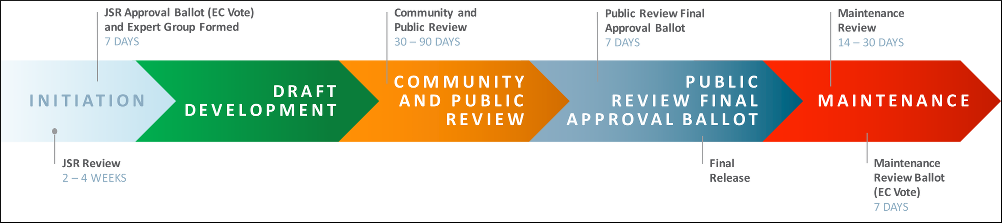
›How does an Expert Group get picked?
The JSR submitter, acting as Specification Lead, is responsible for forming the Expert Group. The goal is to assemble a group that is large and diverse enough to encourage wide adoption of the resulting specification.
Any representative of a Full Member can nominate themselves to serve on an Expert Group. Individuals not currently affiliated with a member can also nominate themselves, but only JCP Members can actually join Expert Groups because all experts must operate under the same legal and IP-sharing terms.
Expert Group members can help shape new and revised specifications, review community feedback, lead the specification effort, and later assume maintenance responsibilities.
›What if I want to comment after the review period has ended?
You can still submit comments on the most current draft of a specification at any time. Review periods are intended to ensure that the Specification Lead and Expert Group leave enough time for feedback, not to prevent future comments.
›How do the latest JCP changes affect general site users?
The changes from recent JCP revisions have been summarized on dedicated pages for each release:
- JCP 2.10: summary of JCP 2.10 changes and the JCP 2.10 document
- JCP 2.8 and 2.9: summary of JCP 2.8 and 2.9 changes, the JCP 2.8 document, the JCP 2.9 document, and the EC Standing Rules
- JCP 2.7: summary of JCP 2.7 changes and the JCP 2.7 document
