About JCP
Get Involved
Community Resources
Community News
FAQ
Contact Us
About JCP
Get Involved
Community Resources
Community News
FAQ
Contact Us

|
|
|
|
|
|
|
 The job of an Executive Committee (EC) representative
is a serious commitment. The time required is extensive, and includes reading of specifications, Reference Implementations (RIs),
and Technology Compatibility Kits (TCKs), as well as regular attendance at EC meetings and teleconferences to discuss and vote on
various technical and process topics. Besides voting on Java Specification Requests (JSRs) at various stages, the EC guides the
Program Management Office (PMO) in the evolution of the Java Community Process (JCP) program. EC decisions can have significant,
long-term consequences to not only the community, but also in the industry and the market. Still, plenty of JCP participants relish
the task of representing a corporation, non-profit, open source group, or themselves. The job of an Executive Committee (EC) representative
is a serious commitment. The time required is extensive, and includes reading of specifications, Reference Implementations (RIs),
and Technology Compatibility Kits (TCKs), as well as regular attendance at EC meetings and teleconferences to discuss and vote on
various technical and process topics. Besides voting on Java Specification Requests (JSRs) at various stages, the EC guides the
Program Management Office (PMO) in the evolution of the Java Community Process (JCP) program. EC decisions can have significant,
long-term consequences to not only the community, but also in the industry and the market. Still, plenty of JCP participants relish
the task of representing a corporation, non-profit, open source group, or themselves.
|
|
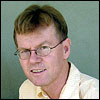
In January 2005, David Girle became the primary representative for
IBM on the ME EC, offering a development perspective to the issues
that arise within that Executive Committee. With 329,000 employees in
75 countries, IBM is the world's largest information technology
company, serving clients in 174 countries. Measured by revenue, IBM
is the biggest provider of IT services ($46B), hardware ($31B) and
financing ($2.6B), and second in software ($15B).
Now a Senior Software Developer at IBM, David previously worked in
the Embedded Systems Group at Object Technology International (OTI)
in Phoenix, Arizona. He holds a Bachelor of Engineering (Electrical)
and a Graduate Diploma in Data Processing. After 15 years engineering
process control systems, he switched to object-oriented software
development in 1993 and began programming in Smalltalk, then in 1998
started using the Java language.
David was responsible for implementing java.net and the underlying
Java Native Interface (JNI) code for VisualAge Micro Edition. He has
been involved in various other Java technology projects as well, most
recently acting as the development lead for SyncML4J, a synchronization
framework written in the Java language.
David first began participating in the JCP program in 2003 when he
participated as an Expert Group member for JSR 226 Scalable 2D Vector Graphics API for
J2ME. Two years later, he joined the JSR 246 Device Management API
Expert Group as a member.
His work in the JCP program is just one example of how David contributes toward the general understanding of Smalltalk and Java technology by
getting involved in local and global efforts to promote them. Other examples are woven through his career: he published white papers on
Synchronization and Messaging Technology (2004), attended the Phoenix Java User's Group meeting to introduce issues related to embedded
development (1999), participated in conferences such as (Object-Oriented Programming, Systems, Languages and Applications
(OOPSLA 1998), and co-led a Smalltalk Special Interest Group meeting on WaterCAD, a commercial application written in Smalltalk (1996).
 . . . . . . . . . . . . . . . . . . . . . . . . . . . . . . . . . . . . . . . . . . . . . . . . . . . . . . . . . . . . . . . . . . . . . . . . . . . . . . . . . . . . . . . . . . . . . . . . . . . . . . . . . . . . . . . . . . . . . . |
|
|